
Climate-Controlled Storage in Bradenton, FL for Your Move
Open a storage unit here in August and the air tells you everything. If it smells like a wet towel, your sofa has been soaking in that for months. Call +1 (941) 392-6022. Bradenton Mover Line connects you with an independent mover that offers storage or can move you into a unit in Manatee County.
“Climate controlled” is printed on a lot of signs, and it doesn’t mean the same thing on each one. This page shows what the label should mean, what climate controlled storage Bradenton facilities charge and what happens to a unit when a hurricane cuts the power.
Calls may be recorded. We may be paid when we connect your call. You pay us nothing.
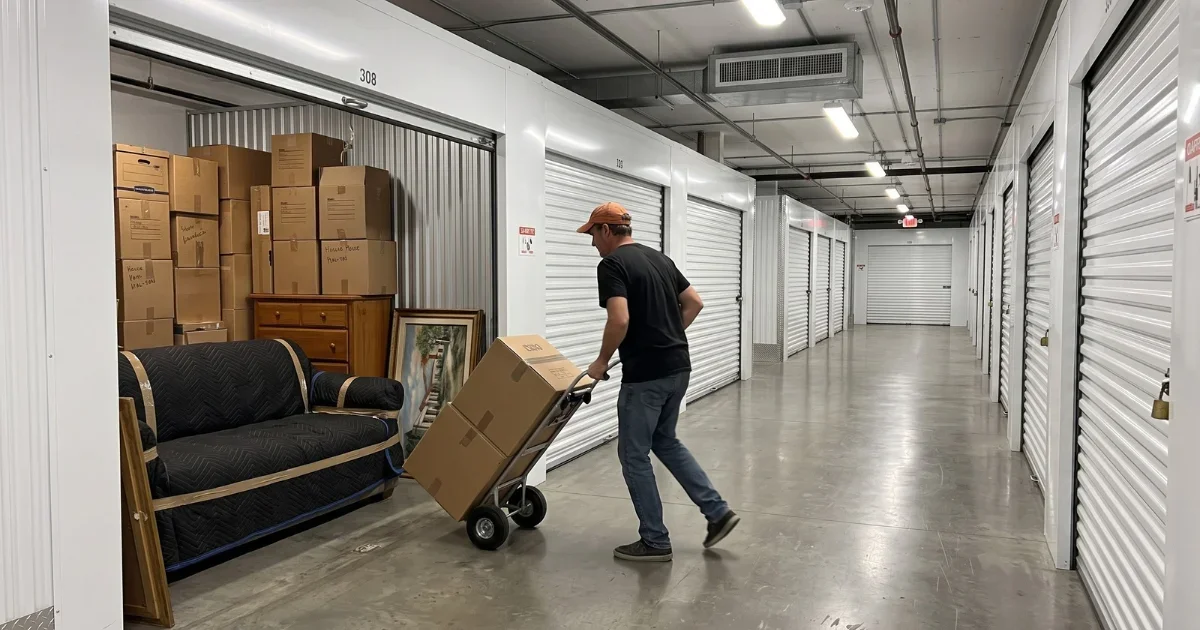
Do You Need Climate-Controlled Storage in Bradenton?
For anything staying through a summer, yes. For two weeks of boxes in January, no.
The reason is humidity more than heat. The EPA’s mold guidance says indoor relative humidity should stay below 60%, and ideally between 30% and 50%. It adds that mold can grow on almost any organic material once moisture is present. Wood, leather, fabric, paper and cardboard all qualify.
Outdoor air in Bradenton sits above that 60% mark for much of the year, and the rainy season runs from late May to mid-October. A metal unit with a roll-up door holds that air in.
Which Storage Help Fits Your Move?
| Your situation | Storage to ask for | Read more |
|---|---|---|
| A few days or weeks between homes | A mover’s warehouse | Short-term storage |
| Months away, a seasonal home or an estate | A climate-controlled unit or vault | This page |
| Art, a piano or antiques | Climate control with humidity limits in writing | Specialty moving |
| Patio sets, tools and bikes | A standard unit | Moving and storage |
| A renovation at home | A portable container, for short stays only. It has no cooling. | Moving and storage |
What Does “Climate Controlled” Mean, and Is It the Same as Air Conditioned?
No, and no rule makes them the same. Modern Storage Media, a trade magazine for storage owners, reports that the industry has no set standard. Operators use “temperature controlled” and “climate controlled” interchangeably, with temperatures kept somewhere between 50 and 80 degrees.
The Self Storage Association draws the line more sharply. By its definition, climate control also controls humidity, and only a system with a dehumidifier counts.
| What the sign says | What it controls | What to ask |
|---|---|---|
| Indoor or interior | Nothing. The unit is inside a building. | Is the hallway cooled at all? |
| Air conditioned or temperature controlled | Temperature | What is the range, summer and winter? |
| Climate controlled | Temperature and humidity | What humidity do you hold, and is it logged? |
Ask to see the reading. Better still, buy a small humidity gauge for about ten dollars and leave it in the unit. It keeps a record you can check on every visit.
Which Items Need Climate Control, and Which Do Not?
Anything that soaks up moisture needs it. Anything you’d leave on a lanai doesn’t.
| Needs climate control | Why |
|---|---|
| Wood furniture and antiques | Wood swells and shrinks as humidity changes, and that can split it, according to the Canadian Conservation Institute |
| Papers, photos and books | The National Archives says to keep them below 75 degrees and below 65% humidity, and out of garages |
| Leather, upholstery, mattresses and clothing | They’re organic, so mold feeds on them |
| Electronics and appliances | Damp air leaves condensation on metal parts |
| Artwork, pianos and guitars | Glue, wood and canvas all move with moisture |
A standard unit is fine for patio furniture, garden tools, bicycles, plastic bins of kitchenware and holiday decorations in sealed totes.
Some things don’t belong in any unit: food, plants, fuel, paint and anything wet.
How Much Does Climate-Controlled Storage Cost in Bradenton?
About $48 a month for a small unit and about $189 for a large one. These are SpareFoot’s average listed prices for climate controlled storage Bradenton FL facilities advertised as of August 2026:
| Unit size | Average monthly price | Roughly holds |
|---|---|---|
| 5 by 5 feet | $20.64 | A closet’s worth of boxes |
| 5 by 10 feet | $48.28 | One room |
| 10 by 10 feet | $77.73 | A one-bedroom apartment |
| 10 by 15 feet | $127.62 | A two-bedroom home |
| 10 by 20 feet | $189.29 | A three-bedroom home |
The averages come from 203 units across the 73 facilities SpareFoot lists here. They’re advertised web rates, which are the lowest price a facility shows.
A mover’s warehouse is priced by the vault, not the room. Those figures are on the moving and storage page.
What Fees and Rate Changes Should You Ask About?
Ask how long the price lasts. The rate on the website is a move-in rate.
Inside Self-Storage, the industry’s trade journal, advises owners to raise an existing tenant’s rent 8% to 15% at a time. Its suggested schedules put the first increase five to seven months after move-in, with 30 days of notice. Florida’s statute on storage contracts and late fees sets no limit on rent increases.
Run the numbers. A $77.73 unit with two 10% increases costs about $94 a year later.
Four more items belong on your list:
- An admin fee at move-in
- A lock you must buy from the office
- A tenant protection plan added to the bill
- The late fee, and how fast a missed payment turns into a lien
That last one matters to seasonal owners. Under Florida’s storage statute, a facility can sell a unit’s contents after written notice, a wait of at least 14 days and two weeks of advertising. Set up autopay before you fly north.
What Happens to Stored Items in a Hurricane or Power Outage?
Two things can go wrong: water gets in, or the air conditioning stops.
Water. “Flood water causes most of the serious storm damage we see across the south,” a storage operator wrote in Inside Self-Storage in June 2026. Ask which Manatee County evacuation level the building sits in. Levels A and B were ordered out ahead of Hurricane Milton in October 2024. A second-floor unit in a building east of US 41 carries less risk than a ground-floor one near the river.
Power. No electricity means no cooling and no dehumidifier. Within days a sealed building turns hot and damp. Ask if the facility has a generator, what it runs and how soon staff walk the halls after a storm.
Insurance. This is the gap people find too late. GreatFlorida Insurance’s 2026 guide says storage coverage generally excludes flooding, and that mold and mildew are generally excluded too. In a 2024 WFTV report, a Florida tenant found $45,000 of furniture ruined in a unit that flooded during Hurricane Ian. Her protection plan excluded flood.
Before storm season:
- Pick an upper floor or an interior unit.
- Raise everything off the floor on pallets.
- Put papers and photos in sealed plastic bins.
- Photograph the unit and keep an inventory.
After a storm, get there as soon as the gate reopens. The EPA says wet items must be dried within 24 to 48 hours to avoid mold.
How Do You Get Items Ready for Storage in Florida?
Dry and clean. Those two words prevent most storage damage in this climate.
- Dry everything. One damp cushion can spoil a whole unit. Facilities turn away wet belongings.
- Clean it. Crumbs in a sofa or a toaster bring insects.
- Drain appliances. Empty the washer hoses, defrost the freezer and prop the doors open.
- Skip the plastic wrap. It traps moisture against wood and leather. Use cotton sheets or moving blankets.
- Leave air gaps. Keep furniture a few inches off the walls and leave a center aisle.
- Trade cardboard for bins. Do it for anything staying longer than a season. Cardboard holds moisture and shelters roaches.
- Add moisture absorbers. Replace them on each visit.
Move in during a dry month if you can. Furniture loaded on a rainy afternoon carries that water inside with it.
What Happens When You Call About Storage?
- You call +1 (941) 392-6022 and say what you’re storing and for how long.
- The line connects you with a mover that has its own warehouse or moves customers into the climate controlled storage Bradenton facilities rent by the month.
- They explain where your goods will sit and what the air is held at.
- You get the storage rate and the moving cost as separate lines, in writing.
Bradenton Mover Line stores nothing and gives no prices.
More Questions About Climate-Controlled Storage in Bradenton
Can Mold Grow in a Climate-Controlled Storage Unit?
Yes. It happens in four ways: items go in damp, the power fails, the unit is packed too tight for air to move, or the “climate control” is only air conditioning.
The trade magazine quoted above warns owners never to promise tenants a mold-free unit. Take that as your cue to check the gauge. For climate controlled storage Bradenton FL renters plan to use for a year or more, a visit every month or two is cheap insurance.
Can You Get to Your Things While They Are in a Mover’s Storage?
Yes, with notice. Warehouse vaults are stacked and sealed, so a visit is by appointment and may carry a fee.
Need to come and go? Rent a self-storage unit with gate hours that suit you.
Are Stored Items Covered if Something Goes Wrong?
Not by the building’s owner. The facility’s insurance covers the facility.
Your cover comes from a tenant plan or your own homeowners policy. GreatFlorida puts off-site coverage on a home policy at around 10% of the personal property limit. Ask every insurer the same two questions: is flood excluded, and is mold excluded?
How Long Can Furniture Stay in Storage in Florida?
For years in true climate control, if it went in clean and dry. In a standard unit, one summer can warp a table and mildew a mattress.
Cost is the other limit. At $77.73 a month, a 10 by 10 unit runs about $1,866 over two years before any increase. Compare that with what the furniture would cost to replace.
Ready when you are
Ready to Talk to a Mover?
One free call. A local mover on the line. A written estimate you can check before you sign.
Have these ready
Both addresses, your date, the home size, and any stairs or heavy pieces.
+1 (941) 392-6022Mon to Sat, 7 AM to 7 PM ET. Calls may be recorded.
Call Now